
If China can operate in India's backyard and systematically expand its influence, then there is no reason why India should feel diffident about operating in areas that China considers its own sphere of influence, argues Harsh V Pant as the Asia Security Summit convenes in Singapore.
How to manage China's rise and mould its behaviour will be one of the biggest diplomatic challenges facing New Delhi in the coming years, says Harsh V Pant.

Amid deepening row with the United States over disputed South China Sea where American ships challenged China's claims of sovereignty, Chinese military has deployed its latest anti-ship cruise missiles which experts say can form a powerful defence line at sea.

In an angry reaction to US Defence Secretary Ashton Carter's remarks that "China's actions could erect a Great Wall of self-isolation" in the South China Sea, Chinese foreign ministry spokesperson Hua Chunying told media that "Carter's remarks reflected typical American style thinking and hegemony".

Any move by India to join the US navy for jointly patrolling the disputed South China Sea will be against its national interest, would divide Asian countries and further escalate regional tensions, a state-run Chinese daily said on Friday.
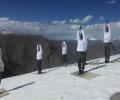
Amid snow-capped mountains and on board warships, India's armed forces demonstrated their impressive yoga skills. Let's take a bow!

China is opposed to India's oil exploration in the South China Sea because it is a disputed area, but regards its ambitious US $46 billion (Rs 2.9 lakh crore) economic corridor through Pakistan-occupied Kashmir a "livelihood project" with issues left over from history.

An international tribunal in the Hague has ruled in favour of the Philippines.

'The worst case scenario is for China to behave like a bull in China shop, and brazenly and wantonly indulge in further encroachments, create obstacles to free navigation and convert SCS into an Air Defence Identification Zone.'

Unfazed by Chinese objections, India and Vietnam today inked an agreement to promote oil exploration in South China Sea along with a slew of pacts, including an extradition treaty, to deepen trade, security and strategic ties between the two countries.

Beijing has been wary of Sanae Takaichi's efforts to boost Japan's military profile since taking office six months ago, points out Dr Rajaram Panda.
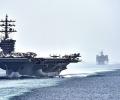
Which are the world's most vital straits, important to shipping?

United States President Donald Trump has said that Iran is under close watch and a 'massive fleet' is heading towards the Gulf region.
China on Wednesday cautioned India against any 'unilateral' attempt to pursue oil exploration in the disputed South China Sea, saying that it is opposed to nations outside the region to intervene in the disputed area.
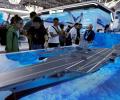
China has commissioned its third aircraft carrier, the Fujian, featuring advanced electromagnetic catapults, amidst rising tensions and military modernization efforts.
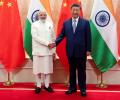
'China's basic purpose of taking the Shaksgam Valley was access to the Indian Ocean.'

Flexing its muscles over Taiwan, China on Monday sailed its aircraft carrier close to the estranged island amid tensions with the US following President-elect Donald Trump's telephone call with the Taiwanese president.

According to www.budgetyourtrip, Asia is home to some of the world's priciest travel destinations.
In the wake of the United States forging alliances in the region, China has softened its stand on the South China Sea disputes saying that it is ready to explore solutions with the countries involved under reasonable conditions.
Taking strong exception to India going ahead with the oil exploration programme in the blocks claimed by Vietnam in the South China Sea, China on Monday raised its pitch saying any exploration activity in its coast would amount to "infringement" of its sovereignty.

The Squad seeks to counter China's power assertions in the South China Sea region.
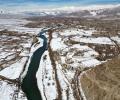
China and Pakistan concluded their strategic dialogue, reiterating their opposition to unilateral actions in South Asia and discussing Kashmir, Afghanistan, and trilateral cooperation.

The US Trade Representative's office removed a social media post featuring a map of India that showed the entire region of Jammu and Kashmir, including Pakistan-occupied Kashmir, as well as the Aksai Chin region as part of Indian territory.

The 'rescue' operation occurred within kilometres of Iran's underground tunnel complex at Isfahan, assessed by the IAEA and US intelligence as holding a substantial portion of the country's 60 per cent enriched uranium stockpile. Retired senior US military officers have highlighted that the mission's footprint -- hundreds of special operators, multiple heavy-lift aircraft deep inside Iran -- appears outsized for recovering a single airman. Prem Panicker continues his must read blog on the Iran War.
China on Tuesday warned the Philippines not to "misjudge" its resolve over a disputed island in the South China Sea, saying it is "fully prepared" to respond to any move by Manila to escalate the situation.

The agreement was to disengage from remaining standoff sites along the Line of Actual Control (LAC), two days before a meeting between Chinese President Xi Jinping and Prime Minister Narendra Modi on the sidelines of the BRICS Summit.
Against the backdrop of a tiff between India and China over the South China Sea, Defence Minister A K Antony on Tuesday called for exercising restraint to resolve the issue while pressing for freedom of navigation and access to resources.

Karex, the Malaysian company that makes roughly one in five of the world's condoms -- about five billion a year, supplying Durex and Trojan among others -- announced this week that it is raising prices by up to 30 percent. The reason is the Strait of Hormuz.
China for the first time deployed a marine surveillance unit with a helicopter to carry out patrolling and observation missions near the contested islands in the South China Sea.

US President Donald Trump has announced plans to clear the Strait of Hormuz to secure the vital oil corridor, citing risks to global energy supplies and criticising other nations' inaction.

The clock on the ceasefire is running out. But everyone's already whispering about round two, possibly as soon as this weekend.

Ever since the Quad started taking shape in 2007, China has been saying that the four-member grouping will be bound to fail. But much to the chagrin of Beijing, it picked up pace in the recent years emerging as a premier strategic group especially challenging China's assertiveness in the disputed South China Sea.
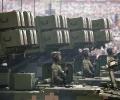
In its annual report to Congress on Tuesday on 'Military and Security Developments Involving the People's Republic of China 2025', the US Department of War said the People's Liberation Army (PLA) is actively considering and planning for additional military facilities.

The cost of the war is being counted not in the corridors of power in Washington or Tehran, but in Firozabad's darkened furnace rooms, Howrah's idle casting sheds, and a barbershop in Kochi where the wait is suddenly, inexplicably, an hour long, notes Prem Panicker in his must read blog on the Iran War.

'As the PLA higher command is almost dismantled and instability spreads, India needs to be prepared for any eventuality,' cautions China expert Srikanth Kondapalli.

'Was the five-day pause ever meant to hold, or was it simply another instrument of signaling, of positioning, of buying time in a war where even the pauses are tactical?' asks Prem Panicker in his must read daily blog on the Gulf War.

The top diplomats of Quad nations on Friday denounced as "inadmissible" any use or threat of use of nuclear weapons in the Ukraine war and strongly opposed any "unilateral actions" that seek to change the status quo in the South and East China Seas, a region that has witnessed increasing Chinese military offensive.

Will rising tensions between US-Israel and Iran threaten crude oil supply through the Strait of Hormuz, putting India's fuel prices, imports, and economic stability at risk?

The LPG squeeze on India's restaurant sector is the quotidian face of a deeper crisis.

FIDE, the world chess governing body, has rejected calls to move the Candidates Tournament from Cyprus despite security concerns arising from regional conflicts. The tournament is scheduled to begin on March 28.
 © 2026 Rediff.com - Advertise with us - Disclaimer - Privacy Policy - Sitemap - Feedback - About us - Terms of use - Grievances